
One outcome of becoming wise-hearted is greater discernment. For starters, let’s define what is discernment.
This Post in a Sentence: Discernment isn’t an inherent skill for a few, but a buildable trait for all.
Some Common Ideas
When asked “What Is Discernment?” many of us think of traits such as intuition and insight. Or, we use phrases such as see around corners, and look below the surface.
The discerning rely, in part, on their gut feelings because it just feels right.
A discerning person sorts out the real from the unreal. They sense true motives while the rest of us think what we’re hearing sounds reasonable.
The discerning think critically, thus they’re not simpleminded enough to believe everything they’ve been told.
A Change of Focus
For Solomon, the focus is on the outcome of using discernment rather than the trait itself.
He defined discernment within the context of leadership, but the application is certainly much broader than that. The answer to “What is discernment?” as given in First Kings 3.9 is as follows:
Discernment is the ability to distinguish right from wrong. To do so, discernment relies on intuition and integrity.
In regard to intuition, Solomon asked for a “… listening heart …” Then, regarding integrity, he asked for the ability to “… discern between good and bad …” See the whiteboard image immediately below.
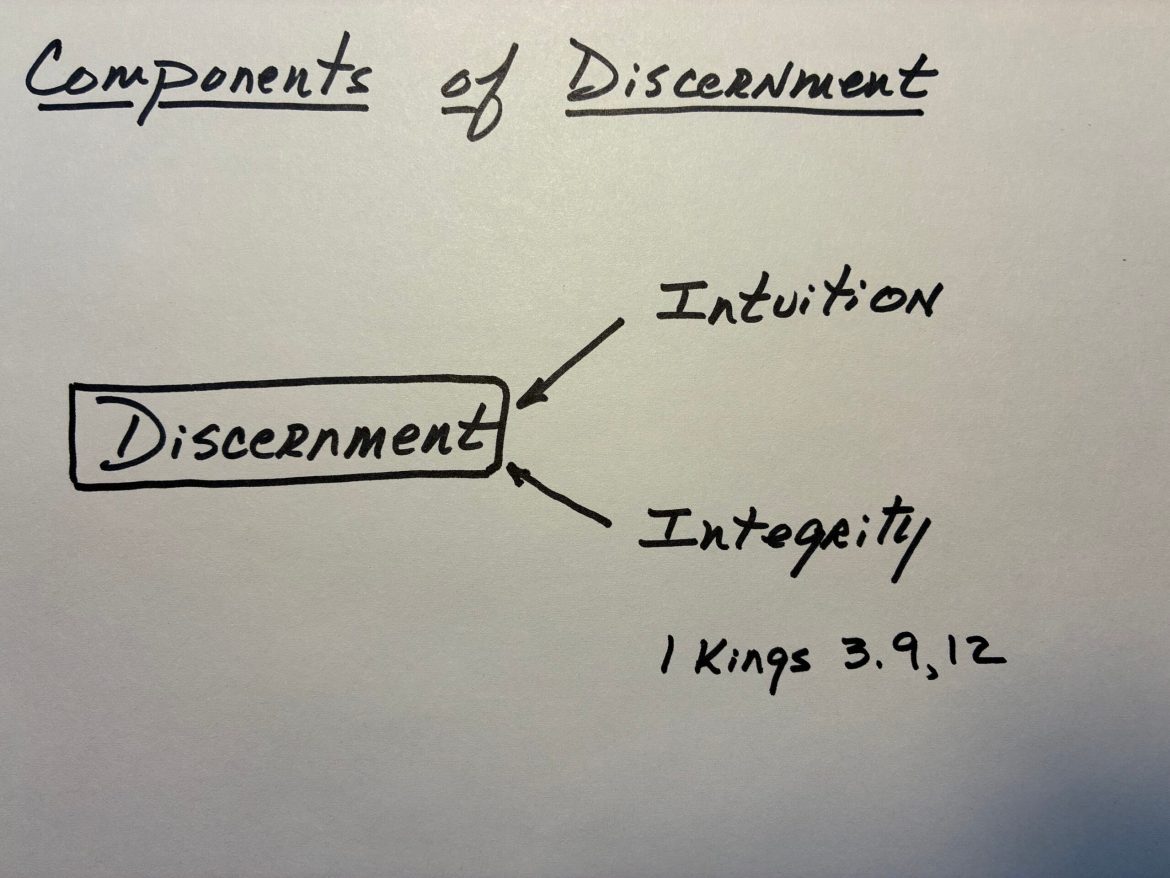
Notice that First Kings 3.9 doesn’t mention our head. Discernment is about our heart, hence our character, rather than our head or native intelligence. Similarly, in Proverbs 8.5, we’re encouraged to discern subtilty, which is an element of a discerning character.
Consequently, discernment is a trait that can be developed over time, if we’re intentional. This invitation to build discernment repeats in Hebrews 5.14 with the phrase “… senses exercised to discern both good and evil.”
Some Similar Teachings
In parallel, in Isaiah 6.9-10 we read this teaching about discernment in the negative. There, we hear teaching but don’t discern its meaning. Moreover, we see outcomes but don’t perceive their true impact. We don’t discern with our heart, verse 10, because we choose not to listen.
By the way, that teaching in Isaiah Chapter 6 is repeated in Matthew 13.14-15 in regard to teaching with parables. Likewise, when we lack a listening heart we fail to discern what is happening around us; Mark 6.52 provides an example of being unable to make sense of life events.
Some Insights to Apply
1). Discernment is especially valuable for interpersonal relations. For example, In Proverbs 2.12 we’re able to deal with people who are really hard to deal with! How so? The prior verses in that chapter point us to developed traits such as discernment, good judgment, and experiential insight.
In like manner, those traits enable us to sidestep the deception of flattery, Proverbs 2.16. Additionally, in Proverbs 23.1 and following, we’re warned to be discerning when interacting with someone of wealth or power because their intentions may be dishonest.
2). When used correctly, discernment will multiply, producing even more discernment in our life. See Proverbs 19.25 for an example of building discernment by learning from the mistakes of others.
3). Discernment isn’t an end in itself. Instead, discernment is a tool to guide our choices and actions. Consider, for example, how a discerning person chooses to do the right thing, as explained in Proverbs 8.9, where sound teaching given to a discerning person leads them to do right. See also Hosea 14.9, where a wise and discerning person lives a just life.
Up Next: It’s reasonable to ask “How do I become more discerning?” Turns out, that’s the topic of the next blog post!
I’m Dale Young. My posts share the balanced life to build wise character and guide wise behavior.
To interact with me, use the links in the Contact Me tab of this blog.
